
The Canada Express Entry 2026 Guide: Category Draws, PNP Focus, and New Strategy
Canada Express Entry 2026 Guide is essential reading for anyone seeking permanent residency, as the system has fundamentally shifted toward targeted selection and labour alignment. For years, the path to obtaining Canadian Permanent Residency (PR) was often a high-stakes competition centered on the Comprehensive Ranking System (CRS) score. The prevailing wisdom was simple: score high or don’t bother. However, as Canada strategically recalibrates its immigration intake through the 2026-2028 Immigration Levels Plan, that reality is changing. The focus has moved from accepting the highest-scoring general applicants to actively selecting the precise skilled workers the Canadian economy needs in specific sectors.
This shift means that succeeding in the 2026 Express Entry landscape requires a complete change in strategy. It is no longer enough to be a highly skilled professional; you must now be a highly skilled professional in a targeted area. The new normal revolves around Category-Based Selection and a significantly increased reliance on the Provincial Nominee Program (PNP). This comprehensive guide will equip you with the knowledge to navigate this new environment, pivot your profile strategically, and master the application process to secure your Invitation to Apply (ITA) in this critical year.
Disclaimer
The information provided in this Canada Express Entry 2026 Guide is based on the 2026-2028 Immigration Levels Plan and current IRCC consultations. It is for informational purposes only. Readers should consult with a regulated Canadian immigration consultant or lawyer for advice tailored to their specific situation, as policies are subject to change.
Understanding the Express Entry Foundation
Before diving into the 2026 strategy, it is vital to understand the basic mechanism that underpins the entire system. Express Entry is not an immigration program itself, but an application management system used by Immigration, Refugees and Citizenship Canada (IRCC) to manage candidates for three primary economic immigration programs:
1. The Federal Skilled Worker Program (FSWP)
The backbone of economic migration, this program targets individuals with skilled work experience who can contribute to the Canadian economy. FSWP candidates must meet minimum requirements for skilled work experience, language ability, and education, and score sufficiently on a 100-point grid before even entering the Express Entry pool. This is the pathway most commonly used by Sri Lankan professionals applying from overseas.
2. The Canadian Experience Class (CEC)
This program is for skilled workers who have recent Canadian work experience (at least one year) in Canada. It acknowledges the value of individuals who have already integrated into the Canadian labour market and community. For those who study or work temporarily in Canada, CEC remains the fastest path to PR.
3. The Federal Skilled Trades Program (FSTP)
A specialized program for skilled tradespeople (e.g., electricians, plumbers, chefs) with a valid job offer or a certificate of qualification from a Canadian provincial or territorial body. While smaller in volume, it is crucial for addressing labour shortages in the trades.
Candidates who qualify for any of these three programs are placed into the Express Entry pool, where they are ranked using the Comprehensive Ranking System (CRS).
The CRS Score Reality in 2026
The CRS score remains the numerical metric used to rank candidates in the Express Entry pool. It is calculated based on four core factors, with points also awarded for secondary and additional factors:
-
Core Human Capital: Age, Education, Official Language Proficiency, and Canadian Work Experience.
-
Spouse/Partner Factors (if applicable): Language skills, education, and Canadian work experience of the accompanying spouse.
-
Skill Transferability: Combinations of strong language skills and foreign work experience, or foreign education and Canadian work experience.
-
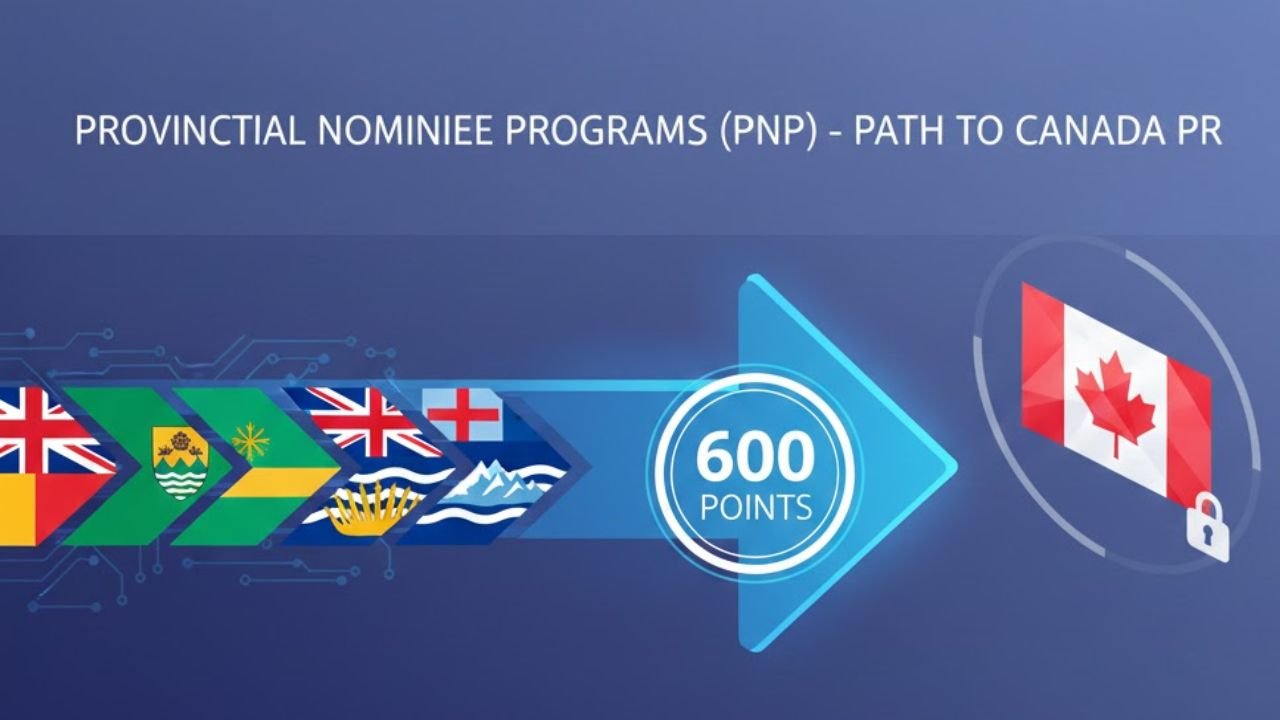
Additional Points: Provincial Nomination (600 points), a valid job offer (50 or 200 points), Canadian post-secondary study experience, or French language ability (up to 50 points).
The Strategic Shift: CRS for All-Program vs. Category Draws
In 2026, the CRS score takes on a dual role:
-
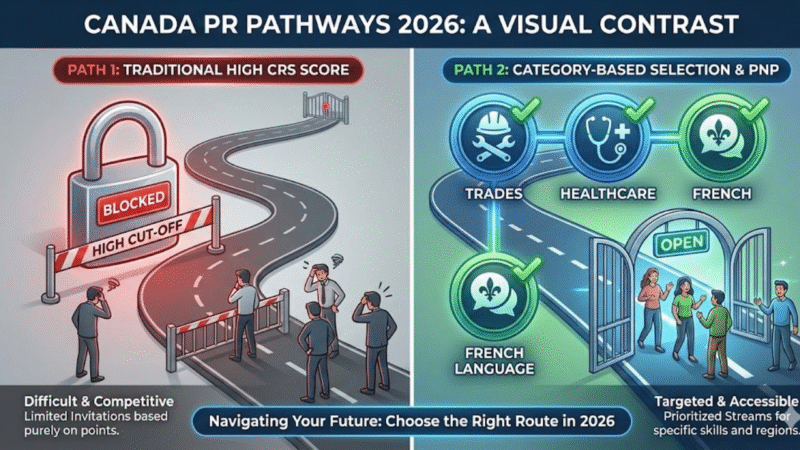
All-Program Draws: These are the traditional draws where IRCC invites candidates from the pool regardless of their occupation or field, provided they meet the FSWP, CEC, or FSTP requirements. Due to the high number of high-scoring candidates remaining in the pool, the cut-off for these draws is expected to remain high—likely in the upper 490s to low 530s—making them fiercely competitive. Achieving scores above 500 will still require top-tier credentials, including a Master’s degree, excellent English or French scores (CLB 10), and significant skilled work experience.
-
Category-Based Selection Draws: This is where the strategy pivots. Introduced to address critical labour market shortages, these draws target candidates based on specific criteria, regardless of their CRS score relative to the All-Program pool. This means a candidate with a CRS score in the mid-400s could receive an ITA if they belong to a targeted category. This is the single biggest change that applicants must strategize around.
The New Normal: Category-Based Selection in 2026
The Canadian government has made it clear that a significant portion of ITAs in 2026 will be reserved for Category-Based Selection. These draws prioritize economic outcomes by inviting candidates with recent experience in one of the identified sectors. The confirmed categories continuing into 2026 include:
-
Healthcare Occupations: Professionals like physicians, nurses, dentists, and related technical occupations.
-
Science, Technology, Engineering, and Math (STEM) Occupations: This large category includes software engineers, data scientists, web developers, and civil engineers.
-
Trade Occupations: Electricians, carpenters, plumbers, and related trades critical for infrastructure and housing projects.
-
Transport Occupations: Truck drivers and those involved in logistics management.
-
Agriculture and Agri-Food Occupations: Workers essential for Canada’s food security sector.
-
French Language Proficiency: This category rewards candidates who demonstrate strong French skills (CLB 7 or higher in all four abilities), regardless of their occupation. This has consistently been a key target area for boosting Francophone immigration outside Quebec.
Anticipating Proposed New Categories
To further refine talent acquisition, IRCC is consulting on adding new, highly specific categories for 2026. While official announcements may vary, savvy applicants should align their profiles with anticipated future needs. These proposed new categories may include:
-
Leadership/Senior Managers: Targeting individuals with experience in high-level corporate governance and strategic decision-making.
-
Clean Energy and Green Technology: Focusing on occupations related to sustainable energy, carbon capture, and climate change mitigation.
Action Point: Pivot Your NOC Code
If your current National Occupational Classification (NOC) code does not strictly fit one of the Category-Based streams, your strategic preparation for the Canada Express Entry 2026 Guide requires either:
-
Slight Re-alignment: Check if your job duties match a targeted NOC code more closely than your current one.
-
Gaining Experience: If feasible, gain at least six months of continuous work experience in a category-aligned field before applying, as this is typically the minimum requirement for category eligibility.
The Most Reliable Pathway: The Provincial Nominee Program (PNP)
The 2026-2028 Immigration Levels Plan confirms a continuous and significant increase in the allocation for the Provincial Nominee Program. The PNP is set to become the dominant economic immigration pathway, outstripping even the primary Express Entry intake. Provinces are given greater autonomy to select immigrants who are best suited to fill their localized labour market needs.
For an Express Entry candidate, securing a Provincial Nomination is the single most important factor for success, as it guarantees 600 additional CRS points, virtually guaranteeing an ITA in the next All-Program draw.
Provincial Strategies for 2026
-
Ontario (OINP): Continues to target specific tech occupations and Master’s/PhD graduates.
-
British Columbia (BC PNP): Focuses heavily on tech, healthcare, and early childhood educators through weekly targeted draws.
-
Alberta (AAIP): Increasingly targets workers in the construction, hospitality, and agriculture sectors.
-
Saskatchewan (SINP): Regularly draws candidates with foreign work experience in in-demand occupations who do not necessarily have a job offer.
Action Point: Dual Strategy
For maximum success in 2026, you must pursue a dual strategy:
-
Express Entry Profile: Create and optimize your profile for federal category draws.
-
Provincial Expressions of Interest (EOI): Research and submit EOIs to the PNP streams of provinces that align with your occupation, and actively monitor provincial draw requirements.

The 5-Step Application Process in the 2026 Context
Even with the shifts in selection, the technical process remains the same. Precision and attention to detail are paramount to avoid rejection after receiving an ITA.
Step 1: Education Credential Assessment (ECA) and Language Testing
Before creating an Express Entry profile, you must obtain an Educational Credential Assessment (ECA) for all foreign education (typically from WES) and take an official language test (IELTS, CELPIP, or TEF/TCF for French). These results are non-negotiable prerequisites.
Step 2: Create the Express Entry Profile
Submit your credentials (age, education, work history, language scores) into the IRCC’s online portal. This profile is valid for 12 months. Ensure your profile accurately reflects your experience to maximize your CRS score and confirm your eligibility for any Category-Based Draws.
Step 3: Receive an Invitation to Apply (ITA)
IRCC holds draws approximately every two weeks, inviting candidates to apply for PR.
-
All-Program Draws: Invites the highest-scoring candidates across all three federal programs.
-
Category-Based Draws: Invites candidates who meet the category requirements and a specific minimum CRS score (often lower than All-Program).
-
PNP Draws: Invites candidates with a Provincial Nomination (600 points).
Step 4: Submit the Electronic Application for Permanent Residence (e-APR)
Once you receive an ITA, you have 60 days to submit your complete application package. This is a strict deadline and requires meticulously collecting and uploading supporting documents. Common reasons for rejection include:
-
Inadequate Proof of Funds.
-
Unclear or incomplete work reference letters.
-
Failing to submit police certificates from every country lived in for six months or more since age 18.
Step 5: Final Checks and Decision
The processing time for Express Entry applications is generally six months or less. During this period, you will be required to undergo a mandatory medical examination by an IRCC-approved panel physician and receive final security and background checks. If successful, you will receive a Confirmation of Permanent Residence (COPR).
Strategic Tips for a Successful 2026 Application
1. Master the French Language
Canada’s strategy to promote Francophone immigration outside of Quebec is the most reliable “cheat code” in the Express Entry system. Achieving a CLB 7 in all four French abilities guarantees qualification for the dedicated French Language Category, often resulting in an ITA with a significantly lower CRS score than the All-Program draws. Furthermore, strong French skills can add up to 50 additional CRS points.
2. Prioritize an ECA from WES
While other organizations can provide an ECA, the World Education Services (WES) is generally the fastest and most recognized by provinces, which is crucial if your strategy relies on a Provincial Nominee Program (PNP) stream.
3. Proof of Funds Must be Liquid
The required settlement funds must be readily available, unencumbered by debt, and held in your name (or jointly with a spouse). IRCC requires a six-month paper trail. Do not rely on selling assets quickly; the funds must be liquid at the time of the e-APR submission.
4. Leverage Canadian Education and Work Experience
While challenging for overseas applicants, if you have the opportunity, a strategic move would be to pursue a short post-graduate certificate or skilled work experience in a targeted Canadian province. Canadian credentials offer valuable CRS points and are the most direct path to the Canadian Experience Class (CEC).
Disclaimer
The information provided in this Canada Express Entry 2026 Guide is based on the 2026-2028 Immigration Levels Plan and current IRCC consultations. It is for informational purposes only. Readers should consult with a regulated Canadian immigration consultant or lawyer for advice tailored to their specific situation, as policies are subject to change.
The Canada Express Entry 2026 Guide: Category Draws, PNP Focus, and New Strategy
Canada Express Entry 2026 Guide is essential reading for anyone seeking permanent residency, as the system has fundamentally shifted toward targeted selection and labour alignment. For years, the path to obtaining Canadian Permanent Residency (PR) was often a high-stakes competition centered on the Comprehensive Ranking System (CRS) score. The prevailing wisdom was simple: score high or don’t bother. However, as Canada strategically recalibrates its immigration intake through the 2026-2028 Immigration Levels Plan, that reality is changing. The focus has moved from accepting the highest-scoring general applicants to actively selecting the precise skilled workers the Canadian economy needs in specific sectors.
This shift means that succeeding in the 2026 Express Entry landscape requires a complete change in strategy. It is no longer enough to be a highly skilled professional; you must now be a highly skilled professional in a targeted area. The new normal revolves around Category-Based Selection and a significantly increased reliance on the Provincial Nominee Program (PNP). This comprehensive guide will equip you with the knowledge to navigate this new environment, pivot your profile strategically, and master the application process to secure your Invitation to Apply (ITA) in this critical year.
Understanding the Express Entry Foundation
Before diving into the 2026 strategy, it is vital to understand the basic mechanism that underpins the entire system. Express Entry is not an immigration program itself, but an application management system used by Immigration, Refugees and Citizenship Canada (IRCC) to manage candidates for three primary economic immigration programs:
1. The Federal Skilled Worker Program (FSWP)
The backbone of economic migration, this program targets individuals with skilled work experience who can contribute to the Canadian economy. FSWP candidates must meet minimum requirements for skilled work experience, language ability, and education, and score sufficiently on a 100-point grid before even entering the Express Entry pool. This is the pathway most commonly used by Sri Lankan professionals applying from overseas.
2. The Canadian Experience Class (CEC)
This program is for skilled workers who have recent Canadian work experience (at least one year) in Canada. It acknowledges the value of individuals who have already integrated into the Canadian labour market and community. For those who study or work temporarily in Canada, CEC remains the fastest path to PR.
3. The Federal Skilled Trades Program (FSTP)
A specialized program for skilled tradespeople (e.g., electricians, plumbers, chefs) with a valid job offer or a certificate of qualification from a Canadian provincial or territorial body. While smaller in volume, it is crucial for addressing labour shortages in the trades.
Candidates who qualify for any of these three programs are placed into the Express Entry pool, where they are ranked using the Comprehensive Ranking System (CRS).
The CRS Score Reality in 2026
The CRS score remains the numerical metric used to rank candidates in the Express Entry pool. It is calculated based on four core factors, with points also awarded for secondary and additional factors:
-
Core Human Capital: Age, Education, Official Language Proficiency, and Canadian Work Experience.
-
Spouse/Partner Factors (if applicable): Language skills, education, and Canadian work experience of the accompanying spouse.
-
Skill Transferability: Combinations of strong language skills and foreign work experience, or foreign education and Canadian work experience.
-
Additional Points: Provincial Nomination (600 points), a valid job offer (50 or 200 points), Canadian post-secondary study experience, or French language ability (up to 50 points).
The Strategic Shift: CRS for All-Program vs. Category Draws
In 2026, the CRS score takes on a dual role:
-
All-Program Draws: These are the traditional draws where IRCC invites candidates from the pool regardless of their occupation or field, provided they meet the FSWP, CEC, or FSTP requirements. Due to the high number of high-scoring candidates remaining in the pool, the cut-off for these draws is expected to remain high—likely in the upper 490s to low 530s—making them fiercely competitive. Achieving scores above 500 will still require top-tier credentials, including a Master’s degree, excellent English or French scores (CLB 10), and significant skilled work experience.
-
Category-Based Selection Draws: This is where the strategy pivots. Introduced to address critical labour market shortages, these draws target candidates based on specific criteria, regardless of their CRS score relative to the All-Program pool. This means a candidate with a CRS score in the mid-400s could receive an ITA if they belong to a targeted category. This is the single biggest change that applicants must strategize around.
The New Normal: Category-Based Selection in 2026
The Canadian government has made it clear that a significant portion of ITAs in 2026 will be reserved for Category-Based Selection. These draws prioritize economic outcomes by inviting candidates with recent experience in one of the identified sectors. The confirmed categories continuing into 2026 include:
-
Healthcare Occupations: Professionals like physicians, nurses, dentists, and related technical occupations.
-
Science, Technology, Engineering, and Math (STEM) Occupations: This large category includes software engineers, data scientists, web developers, and civil engineers.
-
Trade Occupations: Electricians, carpenters, plumbers, and related trades critical for infrastructure and housing projects.
-
Transport Occupations: Truck drivers and those involved in logistics management.
-
Agriculture and Agri-Food Occupations: Workers essential for Canada’s food security sector.
-
French Language Proficiency: This category rewards candidates who demonstrate strong French skills (CLB 7 or higher in all four abilities), regardless of their occupation. This has consistently been a key target area for boosting Francophone immigration outside Quebec.
Anticipating Proposed New Categories
To further refine talent acquisition, IRCC is consulting on adding new, highly specific categories for 2026. While official announcements may vary, savvy applicants should align their profiles with anticipated future needs. These proposed new categories may include:
-
Leadership/Senior Managers: Targeting individuals with experience in high-level corporate governance and strategic decision-making.
-
Clean Energy and Green Technology: Focusing on occupations related to sustainable energy, carbon capture, and climate change mitigation.
Action Point: Pivot Your NOC Code
If your current National Occupational Classification (NOC) code does not strictly fit one of the Category-Based streams, your strategic preparation for the Canada Express Entry 2026 Guide requires either:
-
Slight Re-alignment: Check if your job duties match a targeted NOC code more closely than your current one.
-
Gaining Experience: If feasible, gain at least six months of continuous work experience in a category-aligned field before applying, as this is typically the minimum requirement for category eligibility.
The Most Reliable Pathway: The Provincial Nominee Program (PNP)
The 2026-2028 Immigration Levels Plan confirms a continuous and significant increase in the allocation for the Provincial Nominee Program. The PNP is set to become the dominant economic immigration pathway, outstripping even the primary Express Entry intake. Provinces are given greater autonomy to select immigrants who are best suited to fill their localized labour market needs.
For an Express Entry candidate, securing a Provincial Nomination is the single most important factor for success, as it guarantees 600 additional CRS points, virtually guaranteeing an ITA in the next All-Program draw.
Provincial Strategies for 2026
-
Ontario (OINP): Continues to target specific tech occupations and Master’s/PhD graduates.
-
British Columbia (BC PNP): Focuses heavily on tech, healthcare, and early childhood educators through weekly targeted draws.
-
Alberta (AAIP): Increasingly targets workers in the construction, hospitality, and agriculture sectors.
-
Saskatchewan (SINP): Regularly draws candidates with foreign work experience in in-demand occupations who do not necessarily have a job offer.
Action Point: Dual Strategy
For maximum success in 2026, you must pursue a dual strategy:
-
Express Entry Profile: Create and optimize your profile for federal category draws.
-
Provincial Expressions of Interest (EOI): Research and submit EOIs to the PNP streams of provinces that align with your occupation, and actively monitor provincial draw requirements.
Conclusion
The Canada Express Entry 2026 Guide reveals a system that is more complex but also more accessible to targeted applicants. The power has shifted away from simply scoring high to strategically aligning your profile with Canada’s economic needs. Success in 2026 is defined by alignment—fitting into a Category-Based Selection draw—or nomination—securing an ITA through the Provincial Nominee Program. By mastering the strategic pivot toward Category-Based Selection, focusing on in-demand skills, and pursuing provincial nomination opportunities, you will significantly enhance your chances of joining the thousands of skilled immigrants welcomed to Canada. Start your profile today, align your experience, and make 2026 the year you receive your Invitation to Apply.
External Resources:
PNP Video Resource: This video details the importance of the Provincial Nominee Program, a major pathway for 2026: Top 5 Provincial Nominee Programs (PNP) to Apply for Canada PR.





news via inbox
Nulla turp dis cursus. Integer liberos euismod pretium faucibua