

Navigating the Australia Temporary Graduate Visa Changes 2025: The New Path to PR
Introduction
Australia Temporary Graduate Visa Changes 2025 represent the most profound reshaping of the post-study pathway for international students in over a decade. Driven by the Australian Government’s comprehensive Migration Strategy, these amendments aim to transition the migration system from prioritizing high numbers of temporary entrants to focusing on high-value, high-skill graduates with a genuine, accelerated pathway to Permanent Residency (PR). For Global Lankans pursuing an Australian education, understanding the specifics of these reforms—which took effect primarily from July 2024—is critical to securing a long-term future.
The Temporary Graduate Visa (Subclass 485), the essential bridge between study and skilled migration, has been significantly narrowed. The changes affect three core pillars: eligibility (age), visa length, and stream alignment. The popular two-year extension for “select degrees” has ceased, and the maximum age for most applicants has been dramatically lowered from 50 to 35. This comprehensive guide will dissect the Australia Temporary Graduate Visa Changes 2025, providing detailed strategies for graduates to maximize their time on the 485 visa and strategically position themselves for the next step: the new Skills in Demand visa and eventual PR.
[DISCLAIMER]
This article provides general information regarding the Australia Temporary Graduate Visa Changes 2025 and is not a substitute for professional legal advice. Australian migration law is subject to continuous policy updates, particularly under the new Migration Strategy. Readers must consult with a registered Migration Agent (MARA) or the official Department of Home Affairs website for accurate, personalized advice.
Section 1: The New Subclass 485 Eligibility Landscape
The most immediate and restrictive changes relate to who is now eligible to apply for the Temporary Graduate Visa (TGV).
1.1 The Age Limit Reduction: From 50 to 35
A critical change implemented in July 2024 is the reduction of the maximum eligible age for most TGV applicants from 50 to 35 years old.
-
Impact: This change severely limits the TGV pathway for older applicants, including those pursuing second-career Master’s degrees or those who undertook studies later in life.
-
Key Exceptions: The age limit of under 50 years still applies only to applicants who:
-
Are using a Master’s (research) or Doctoral Degree (PhD) to meet the study requirement.
-
Hold a Hong Kong or British National Overseas passport.
-
This adjustment strongly signals that the Australian government is prioritizing younger graduates who have more time to contribute to the workforce and settle long-term.
1.2 Stream Realignment and Renaming
The Subclass 485 visa streams have been renamed and strictly aligned to the level of the qualification completed in Australia:
| Old Stream Name | New Stream Name | Eligible Qualification | Key Requirement |
| Graduate Work Stream | Post-Vocational Education Work Stream | Associate degree, diploma, or trade qualification. | Qualification must be closely related to a nominated occupation on the relevant skilled occupation list (MLTSSL). |
| Post-Study Work Stream | Post-Higher Education Work Stream | Bachelor’s, Master’s, or Doctoral degree. | No required link to a skilled occupation list. |
-
Post-Vocational Education Work Stream (Diplomas/Trades): This stream retains the requirement for a skills assessment and a relevant qualification, making it tightly linked to skills shortage lists. The visa duration remains 18 months.
-
Post-Higher Education Work Stream (Degrees): This stream continues to provide a more flexible post-study period for degree-level graduates, regardless of their field of study.
1.3 Higher English Language Requirements
Effective from March 2024, the English language standards for the 485 visa have also been raised to ensure graduates can more effectively integrate into the Australian workforce:
-
The minimum required score for IELTS (or equivalent test) has increased from an overall 6.0 to 6.5 (with a minimum score of 5.5 for each component).
-
The validity period for the English test result has been reduced to one year before the visa application is lodged (previously three years).
Section 2: Reduced Visa Durations and the End of Extensions
The most impactful change for strategic planning is the reduction in the amount of time graduates are granted to stay and work in Australia. The previous “select degree” extension has been eliminated for new applications.
2.1 Shorter Stay Periods
The stay periods under the Post-Higher Education Work Stream are now fixed and reduced:
| Qualification | New Visa Duration | Previous Duration (Pre-July 2024) |
| Bachelor’s Degree (including Honours) | Up to 2 years | Up to 2 years |
| Master’s (Coursework and Extended) | Up to 2 years | Up to 3 years |
| Master’s (Research) and Doctoral Degree (PhD) | Up to 3 years | Up to 4 years |
-
The Loss of the Select Degree Extension: The highly valued extension, which previously added two extra years for certain high-demand courses (like Nursing, Engineering, IT), has ceased for new applications. This necessitates an immediate and aggressive job search strategy upon graduation, as the window to secure a sponsored visa has shrunk.
2.2 The Second Post-Higher Education Work Stream (Regional)
The second TGV stream remains in place and is now more crucial than ever for maximizing post-study time and accumulating PR points.
-
This stream is available to those who studied at an educational institution located in a designated regional area and who have continued to live in a regional area while holding their first TGV.
-
The duration is 1 to 2 years of additional time, depending on the remoteness of the area studied and lived in.
-
Strategic Advantage: This extension not only provides additional work experience time but also contributes 5 bonus points towards the Skilled Migration Points Test, making it the most vital pathway for Lankans focused on PR.

Section 3: The New PR Path: Skills in Demand Visa
The purpose of the TGV has changed: it is no longer a holding visa but a testing period designed to channel high-skilled graduates directly into a clearer PR pathway, primarily through the new Skills in Demand (SID) visa (Subclass 491/190 related).
3.1 The Shift to the Skills in Demand Visa
The Australian Migration Strategy clearly links the TGV period to securing the next visa: the Skills in Demand visa, which is set to replace the existing Temporary Skill Shortage (TSS) visa (Subclass 482).
-
TGV as a ‘Trial Period’: Graduates must utilize their 485 visa period to gain skilled employment. If they can secure a job that meets the new skills and salary thresholds, the employer can nominate them for the SID visa.
-
PR Pathway: The SID visa is structured with three tiers—Specialist, Core, and Essential—and provides a clearer and faster route to permanent residency than previous temporary employer-sponsored visas. This direct connection makes the TGV period critical for job hunting.
3.2 The Importance of a Positive Skills Assessment
For all skilled migration pathways (Skilled Independent 189, State Nominated 190, and the new SID visa), a positive skills assessment from the relevant assessing authority is mandatory.
-
Timing: Graduates must obtain their skills assessment while on the TGV. This process can be lengthy (e.g., Vetassess, Engineers Australia, ACS for IT).
-
Professional Year (PY): For graduates in high-demand fields like IT, Accounting, and Engineering, completing an accredited Professional Year Program while on the TGV is a powerful strategy. The PY provides an extra 5 points for the PR points test and often satisfies the skills assessment work experience requirement.
3.3 Maximizing Points on the Skilled Migration Test
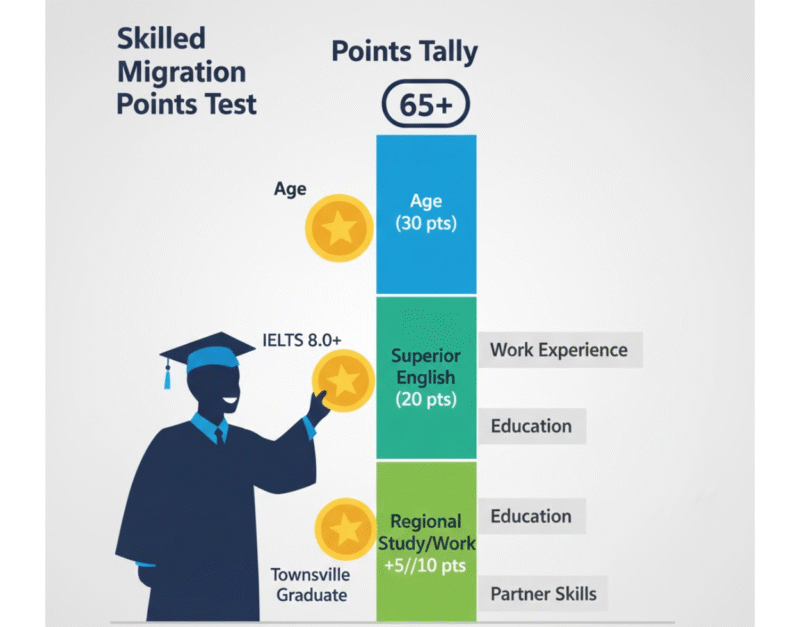
With increased competition, successful PR applications often require 90 to 100+ points. Graduates must use the TGV period to maximize their score:
| Points Category | Strategy on TGV | Points Gained |
| Age | Apply while still in the 25–32 age bracket. | Maximum 30 points |
| English | Aim for Superior English (IELTS 8.0+ or equivalent). | Maximum 20 points |
| Australian Study | Complete an Australian degree. | 5 to 15 points |
| Regional Study | Study for at least two years in a regional area. | +5 bonus points |
| Professional Year (PY) | Complete a PY course in IT, Engineering, or Accounting. | +5 points |
| Skilled Employment | Accumulate 1-3 years of full-time Australian experience. | 5 to 15 points |
Section 4: Strategic Advice for Global Lankan Graduates
Given the Australia Temporary Graduate Visa Changes 2025, a passive approach is no longer viable. Graduates must adopt a proactive strategy focused on maximizing their PR potential during the shorter TGV period.
4.1 Choosing the Right Qualification Level
With the age limit relaxed for PhD and research Master’s graduates (under 50) and a longer TGV duration (3 years), pursuing a research-focused degree or PhD offers a significant advantage for those seeking long-term settlement. These higher qualifications also attract maximum points on the Skilled Migration Test.
4.2 Embrace Regional Australia
The Regional Australia strategy is now the strongest migration play for international students.
-
Extended Stay: Access to the Second Post-Higher Education Work Stream (additional 1-2 years).
-
PR Priority: State and Territory nominations (Subclass 190) often prioritize applicants who have studied and worked in their regional areas. Regional nominations are generally less competitive than the independent skilled visa (189).
-
Points Bonus: The guaranteed 5 bonus points for regional study.
Graduates should actively seek employment in designated regional centers immediately upon graduation, leveraging the increased focus on addressing regional skills shortages.
4.3 Navigating Onshore Student Visa Restrictions
From July 2024, the government restricted the ability of TGV and Visitor visa holders to apply for a Student Visa onshore.
-
Implication: TGV holders cannot use a second course as a ‘holding mechanism’ to remain in Australia while waiting for a PR invitation. The time on the 485 visa must be spent exclusively on gaining skilled employment and PR points, or the graduate must depart the country.
Conclusion
The Australia Temporary Graduate Visa Changes 2025 reflect a necessary evolution in Australia’s immigration policy, moving towards a system that favors highly skilled, young workers who demonstrate a clear commitment to the Australian economy. For Global Lankans, this means the post-study phase is now a high-stakes, time-sensitive sprint.
Success hinges on making a strategic choice of qualification (higher and regional preferred), immediately seeking skilled employment, leveraging the Second TGV stream, and proactively maximizing PR points through Superior English scores and a positive skills assessment. By understanding and adapting to these new rules, graduates can successfully convert their Australian educational investment into a clear and attainable pathway to permanent residency.
OUR TOP PICK
Essential Resource for Your Australian Professional Career
The CV Book & The Cover Letter Book by James Innes (Amazon AU)
Transitioning from a student to a professional in the Australian job market requires more than just a qualification; it demands a resume (often called a CV) and cover letter formatted to Australian industry standards. The Australian job application culture often differs from that of South Asia and the UK.
James Innes’s books are highly recommended resources that provide insider tips on crafting documents that stand out to Australian recruiters. The CV Book ensures you avoid common mistakes and structure your resume according to local expectations, while The Cover Letter Book shows you how to write a compelling, tailored letter—an essential tool for securing the skilled employment necessary to transition from the 485 visa to the Skills in Demand visa.
Find The CV Book and The Cover Letter Book (often available as a bundle or individually) on Amazon AU to optimize your job applications.





news via inbox
Nulla turp dis cursus. Integer liberos euismod pretium faucibua